- Home
- Fresh Produce Knowledge
- Produce Supply Chain
- Fresh Produce Economies of Scale
Fresh Produce Economies of Scale
Economies of Scale
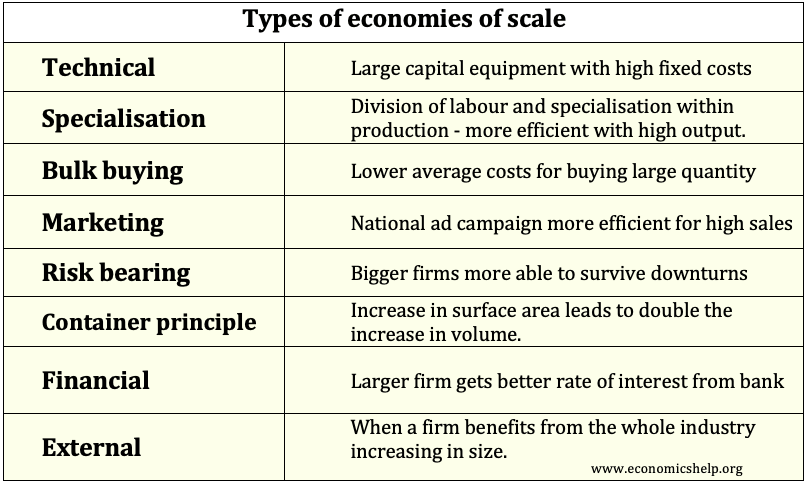
Before we look at Fresh Produce Economies of Scale, we need to cover the generic term 'Economies of Scale', which is an expression drawn from the microeconomics environment. There are numerous definitions in circulation. My preferred one is from The Economist magazine: "Economies of scale are factors that cause the average cost of producing something to fall as the volume of its output increases."
The image to the right takes matters a step further by segmenting the economies of scale concept into several types.
Fresh Produce Economies of Scale
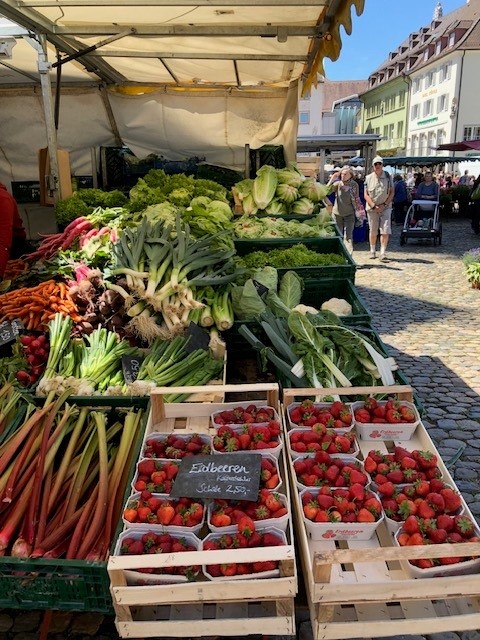
As one might suspect, this concept also has some application in the fruit & vegetables trade. Of particular interest within our industry are the 'specialisation', 'bulk buying' and 'risk bearing' segments. The more land a grower puts under the plough, the more he can grow. The more retailers a wholesaler services, the more produce he can sell to those retailers. The more stores a retailer has, the more produce he can buy.
And up to a point, this is absolutely correct. On that basis, the grower element of the fresh fruit and vegetables supply chain strives to achieve greater economies of scale in its own right. In addition to that industry generic urge, the globalisation of the retail industry has served to increase the pace of the fresh produce trade at large attempting to improve economies of scale.
It sounds quite simple, really. The more I produce, the cheaper the cost of production. In theory anyway.
One of the challenges with this concept, however, is that it is linear in nature and therefore only works until it hits a wall. And, of course, there are different perspectives.
The Growers' Perspective
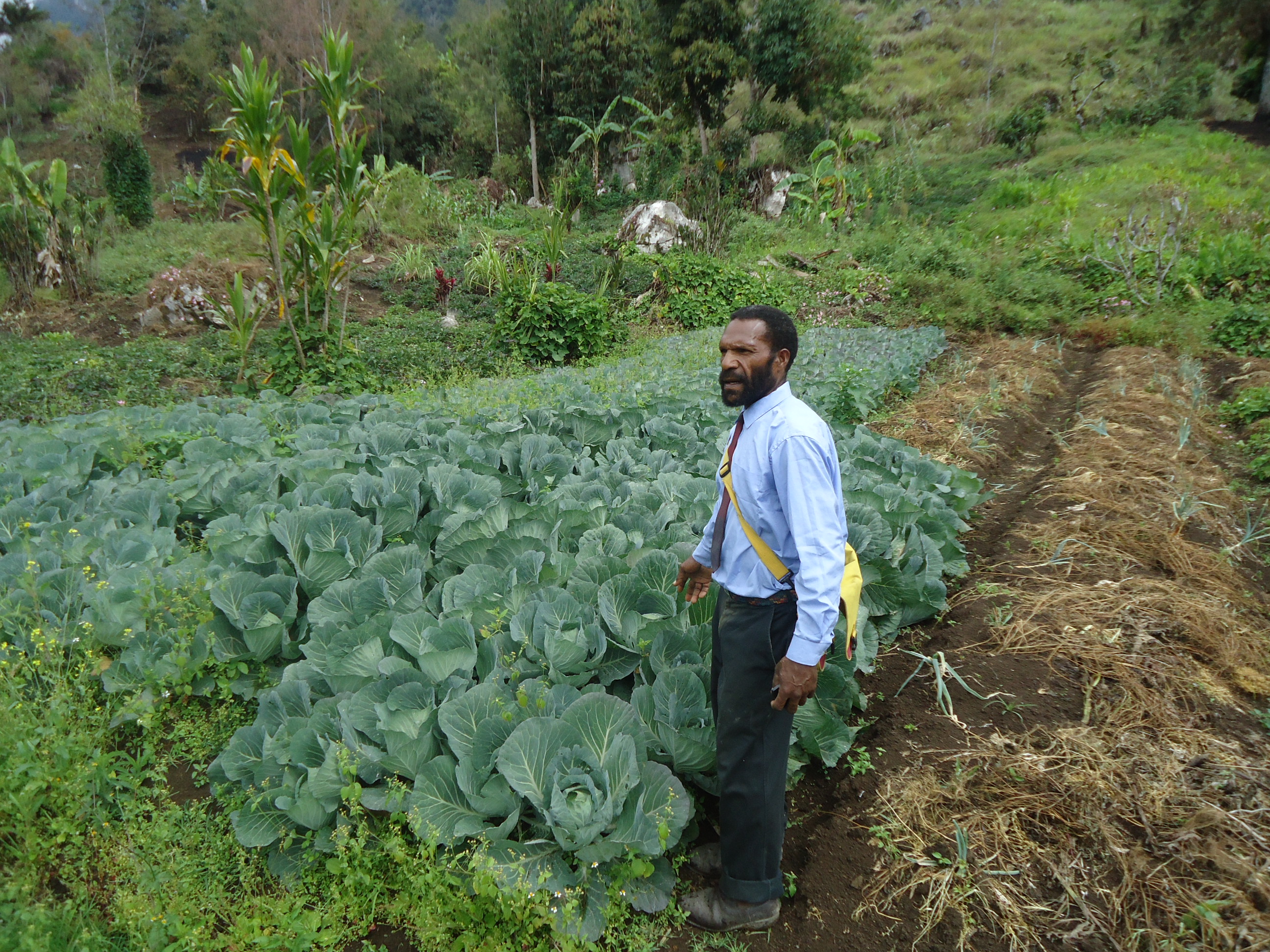
Growers needs to earn more from selling their crops than what it has cost them to grow, harvest, pack and market the crops. Increasing crop acreage, mechanizing the production, harvest and package processes, increases in cost effectiveness, the larger the production acreage is, and becomes a necessity in its own right, in relation to labour availability and cost.
Multiple cabbage growers, for example, substantially increasing their production acreage from one growing season to the next, without there being certainty that their additional crop volumes are addressing an already known supply shortage based on increased demand, will potentially either plug the known supply gap because they are getting it 'just right', or crash the market through oversupply.
Either way, mixed emotions come into play. A crashed market through oversupply makes for unhappy growers and consumers who develop false value perception of the crops involved, which increasing the challenge for growers and retailers alike, to present price points in future seasons that consumers will accept.
There is always the risk that a 'just right' position in any particular growing season may be considered to be the status quo for coming seasons by consumers, who do not appreciate the commodity price fluctuation potential and the fresh produce risk matrix.
The Retailers' Perspective
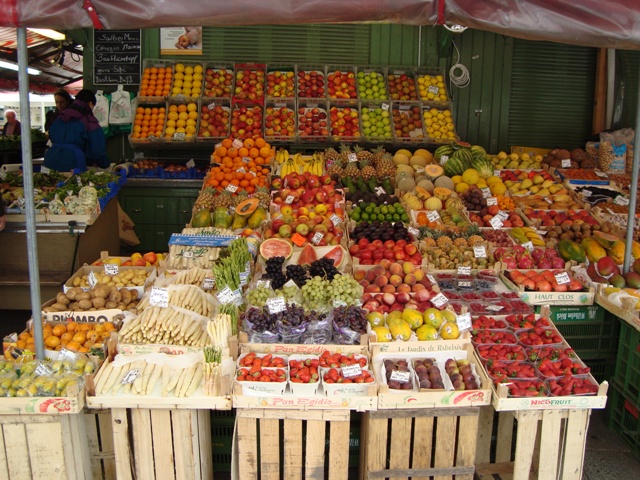
Consumers generally assume that supermarkets should always be the cheapest place to purchase fruits and vegetables, because their ability to buy large volumes of produce, and large volumes are typically associated with lower cost.
Right?
Well, in principle, yes, but the devil is always in the detail! The 'lower price for higher volume purchased' mechanism is a widely distributed and generally understood lever of how markets and economies work. An often overlooked aspect of that lever is the 'supply and demand' equation. Economic market theory works on the principle that when supply and demand are in an equilibrium, i.e., a balanced state exists between those forces, the market can be relied upon to determine the correct price.
Today's corporate produce retailers operate to in-house standards on their produce range, quality, pack size, brand, food safety and cool chain considerations, all aimed at what Foodtown founder Tom Ah Chee referred to as his C.S.T.S.Y.B. principle, but to a level where elements of these standards can often acts as constraints. This leads to supermarket produce buying departments at times incurring higher incremental costs than those associated by consumers with the retailers' perceived purchasing power.
Practical Example Involving Both Grower and Retailer

Large growers love nothing more than finding a buyer for their entire crop. They therefore trend towards large retailers, either directly or through brokers, who have a need for large volumes of consistent quality and therefore trend towards large growers!
Having found each other, retailer and grower then agree on a market model, which in our example involves buying 6 count Cauliflower in one way cardboard boxes, carrying the seller's brand - which in this particular case is a large French cooperative, Prince de Bretagne.
There are other considerations to be worked through if these Cauliflower end up on our hypothetical retailer's shelves via direct purchase. But regardless of the supply channel taken by the Cauliflower as it travels from packhouse to retail - what do you think is going to happen to the agreed price, if:
- cold weather restricts Cauliflower growth and the grower wants to switch to 8 count?
- warm weather encourages excessive growth and the grower want to change to 4 count?
- the ability to supply 6 count Cauliflower boxes is compromised through a packaging supply shortage in that size?
Just to mention a few questions that could potentially lead to a supply and demand equilibrium no longer being in balance, therefore leading to price fluctuations that are no longer driven by the Economies of Scale principles, despite the Economies of Scale concept clearly being applicable to both retailer and grower in the example given.
I have hopefully been able to convey the message here, that Fresh Produce Economies of Scale are a complex topic, which you will undoubtedly meet again, directly or indirectly, on other pages of this website.
You might like these
Produce Supply Chain
Effective fresh produce supply chain management is a complete wrap of skill, science and art.
Fresh Produce Supply Chain Structure
An observation about Fresh Produce Supply Chain Structure
Fresh Produce Middlemen
An introduction to the role of middlemen in the fresh produce supply chain.
Produce Retail Choice and Consequence
Where the changing face of produce retail choice and consequence is discussed.
Fresh Produce Consistency
Where the importance of fresh produce consistency for consumer confidence is discussed.