- Home
- Fresh Produce Knowledge
- Produce Supply Chain
- Fresh Produce Middlemen
Fresh Produce MiddleMen
Fresh Produce Middlemen - An Attempt To Square The Circle
Fresh Produce Middlemen have been around since Adam was a cowboy. 'Middlemen'. Just letting the word roll off your tongue evokes emotion. ‘Middlemen’ are often viewed as the people in any supply chain who add no value, accept no responsibility, and cannot be trusted as they have no real stake in what they pretend to be doing.
At this stage I would expect readers to segment into two groups. The first group being in total agreement and wondering what took me so long to define the term so aptly. The second group are now looking for the meat cleaver and getting ready to chase me, as, in their view, I have just confirmed my bigotry in relation to what they see as a very critical part of the produce value chain.
In response I would like to cite three English language sayings I have grown fond of over the years:
- The proof of the pudding is in the eating.
- The truth lies somewhere in the middle.
- You gets what you pays for.
Anyone attempting to take costs out of a supply chain at any point of time, should quite rightly examine how the chain is structured, how many participants the chain consists of, what role each participant is meant to perform, and how close each participant’s performance comes to the original intent as opposed to today’s reality.
Auctioneers - Fresh Produce Middlemen From Days Gone Past
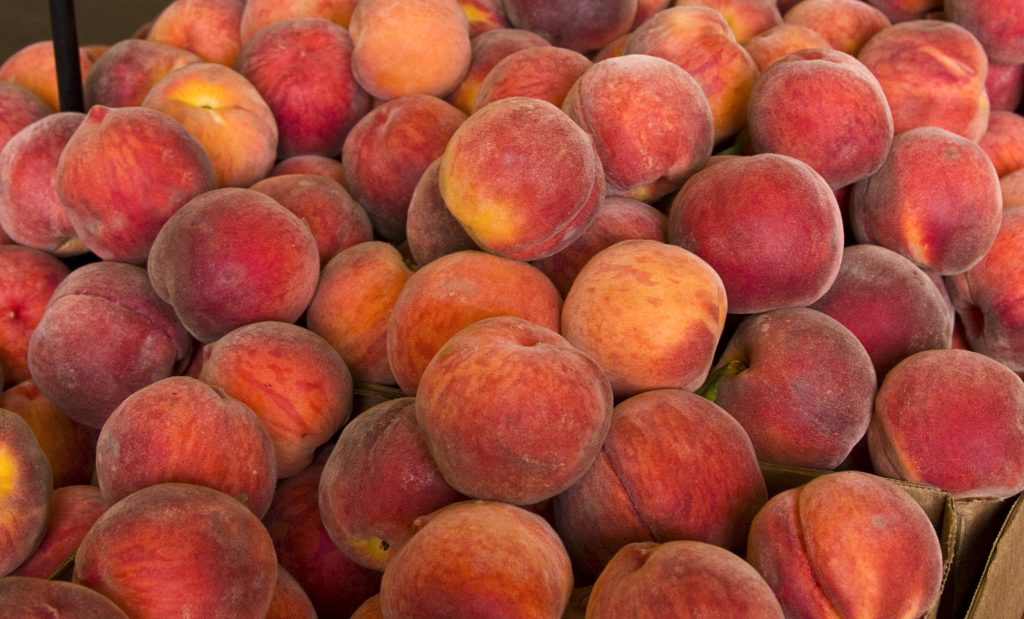
The auctioneer was an employee of the auction house. It was his job to sell the produce on behalf of the growers to bidding buyers. The auctioneer started with an information deficit. Auctioneers were assigned to specific crops to help them understand and act upon market changes that would occur during each crop's seasonal sales cycle.
Let's take peaches, for example.
The auctioneer knew that it was peach season; he knew that there were growers out there who had peaches for sale; and, if he knew his job, he probably knew those growers by name. But he did not know until the auction floors opened to receive peaches, how many growers would deliver the peaches to his auction, as opposed to a competitor auction house which invariably existed and most likely in close proximity.
The auctioneer did not know how many peaches growers would deliver. He did not know what quality grade or fruit size he could expect - and he did not know how many buyers would be turning up for auction. Nor did he know how many peaches would be purchased by those buyers who would turn up. He did know, all things being equal, that he would be conducting a peach auction where the volume of peaches on hand would be sold for a range of prices to a group of buyers.
The auctioneer was focused on the day's sale. He wanted that sale to be successful. This meant he needed to have enough peaches of an acceptable quality there to ensure buyers could satisfy their demand and the growers responsible for supply were receiving an acceptable price. On top of that, the auctioneer wanted the margin he earned in dollar terms to be acceptable as his commission was expressed as a percentage (and fixed at 10%) and that peaches and buyers would turn up in sufficient numbers again on the next auction day.
The scenario I have just described was the most basic equation that ensured a successful sale. Each party involved measured success with a different yardstick. Growers deemed the sale to be successful if they received a price they perceived to be in excess of their production and marketing costs. Perception being the operative word as growers in many cases operated without hard facts. The auctioneer felt happy with the result if all the peaches had been sold and if the overall result had created an acceptable margin for the auction house. Retail buyers had a successful auction result if they managed to get the right volume, at the right quantity, at the right price and at the right condition into their stores.
Distribution Centres & Category Managers
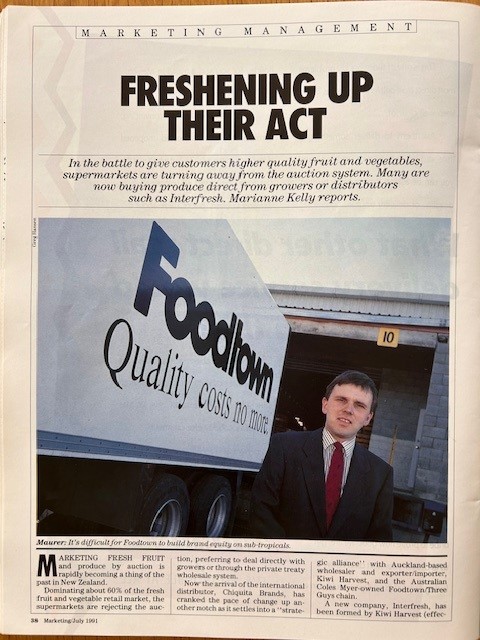
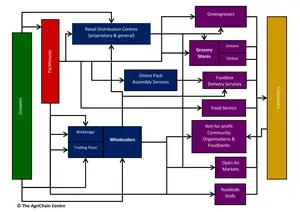
The auction is gone. Wholesale markets are still an important part of the Fresh Produce Supply Chain, as are the supermarket produce merchandise departments which buy their produce direct from growers and packhouses, and their distribution centres, and act as dedicated retail channel consolidation points, bypassing wholesale market trading floors.
In this photograph, I am standing next to one of our Foodtown Supermarkets trucks, parked next to the recently opened first dedicated fresh produce retail distribution centres.
The year was 1989 and we had just exited the auction system.
The auction has been replaced with price negotiation frameworks conducted at wholesale level. Supermarket chains globally prefer to buy their produce directly from growers and packhouses. This means volumes destined for those consumer channels bypass the wholesale trading floors which have replaced the auction systems.
The wholesale markets are being referred to as terminal markets in the US, that is, the markets where the produce ends up that cannot be sold directly. As a consequence, a straight-forward daily demand/supply equilibrium indicator used by the entire value chain for their price negotiations no longer exists and pricing decisions are made on the basis of individual transaction within discrete supply chains instead.
The Middlemen might have reduced by moving from auction to direct purchasing where ever possible, but the professional life of merchandise managers, category managers and retail buyers had just become a lot more complicated.
More about that in due course!
Fewer Fresh Produce Middlemen comes with Consequences
When pursuing one’s line of inquiry about the use of middlemen in one's supply chain, one critical question needs to be asked and that is, “how will my supply chain perform if I remove a participant that I consider to be a middleman from the equation?”
To answer that question, one first needs to determine whether the considered ‘weak link’ is adding any value. That in turn requires some thought to be given to the definition of value and the way value should be measured across the supply chain.
Not every supply chain participant contributes value in the same format or to the same level, but all participants should be contributing a level of value appropriate to their role in the supply chain and in an agreed upon measurable format. I can therefore only hope that anyone reviewing their supply chain in search of supposedly non-value adding middlemen elements is a structured thinker, who knows what they are doing.
A refrigerated trucking business contracted to ship stone fruit from Central Otago to Auckland, for example, is not a middleman but an essential service provider. If such a company breaches its service covenant often enough, they will ultimately be replaced, but no leveraged force in a supply chain interested in getting good quality stone fruit to consumers would attempt to eliminate the refrigerated transport element of the supply chain altogether.
Knowledge providers or product consolidators on the other hand are often at the receiving end of middlemen elimination attempts – particularly when the organisation using their services have little or no knowledge of the intrinsic value these middlemen might possibly add.
My advice therefore is proceed with caution, understand your business model, and develop viable alternatives before heading down the elimination route.
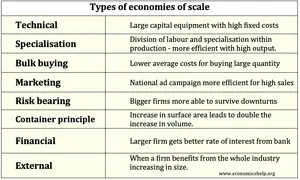
And somewhere within this mix, the Economies of Scale concept would be worth considering.
You might like these
Produce Supply Chain
Effective fresh produce supply chain management is a complete wrap of skill, science and art.
Fresh Produce Supply Chain Structure
An observation about Fresh Produce Supply Chain Structure
Produce Retail Choice and Consequence
Where the changing face of produce retail choice and consequence is discussed.
Fresh Produce Economies of Scale
Economies of scale are critical in the fresh produce business, as commodity farm gate returns can fluctuate from one season to the next.
Fresh Produce Consistency
Where the importance of fresh produce consistency for consumer confidence is discussed.