- Home
- Fresh Produce Knowledge
- Produce Supply Chain
- J Wattie Canneries Impact Reflection
J Wattie Canneries Impact Reflection
Brief Explanation
This J Wattie Canneries Impact Reflection page was not due to be written at this point in time. I have planned the entire website, based on the headings you can see in the navigation bar. Somewhere within there, I knew that I would need to find space for the paradox that arises, when we start talking about the fresh produce supply chain. The paradox being, that a part of fruit and vegetable production volumes aimed at fresh consumption are often diverted to processing, when crops either do not fit the quality standards for fresh consumption, or when market conditions such as oversupply suggest this approach. Then, of course, there is the processed produce supply chain that operates in pararallel, and alongside, its fresh produce supply chain "cousin".
But then reality takes over and events in the market place can alter even well thought-through constructs such as this website. So, we need to discuss elements of the processing aspect of our supply chain now.
Consumer Channel Segmentation
Growers are realists. They know it would be actually fantastic if they could sell every apricot off every apricot tree. Every strawberry off every strawberry plant. Every asparagus spear from every asparagus row. But that is not how Mother Nature works. And knowing that there is processing capacity available that can be accessed either on a seasonal basis or through longer-term contracts, where part of the crop is hived off into the processing channel, is not just confidence-building for the growers, but also for others who are supporting that growing venture , such as input providers or bankers.
One of the New Zealand fresh produce industry sectors which is able to collect and collate reliable production and consumer channel data is New Zealand Apple & Pears Inc. In a submission to government they detailed the pathways their annual apple and pear crop takes to reach consumers as follows:
"In 2020 the New Zealand apple and pear industry covers 10,396 hectares and produces 587,000 tonnes of apples and pears. Of these 402,000 tonnes are exported, 68,000 tonnes are sold on the domestic market as fresh fruit, and 117,000 tonnes are processed into other products."
Not every produce category would have this consumer channel data ready at their fingertips - and no two categories are the same. But the apple and pear data provides the evidence that the processing component of crops can be very significant.
J Wattie Canneries Impact Reflection
In September 2025 reports emerged of Heinz Wattie advising Hawkes Bay peach growers that the company was not renewing their supply contracts for the 2026 season. At first glance, you may wonder why that would be newsworthy. But anybody who knows a little bit about Heinz Wattie and their origin would know that peaches, and particularly Golden Queen peaches, were once one of the company's signature products.
It did make me wonder what was going on.
Earlier this week, media reported that Heinz Wattie are planning to close their Auckland, Christchurch and Dunedin factories.
So this is most certainly bigger than not wanting to renew contracts with one particular grower category, i.e. peach growers. And within the context of certainty and confidence being key elements of a wholistic fresh produce category supply chain, this decision has the potential to impact far beyond of just what Heinz Wattie are up to. The magnitude of this news is such, that it deserves a closer look at the company, and specifically the origins of the company, because it may surprise some of the readers here that Heinz Wattie hadn't always been called Heinz Wattie.
This leads us to why this page carries the title "J Wattie Canneries Impact Reflection".
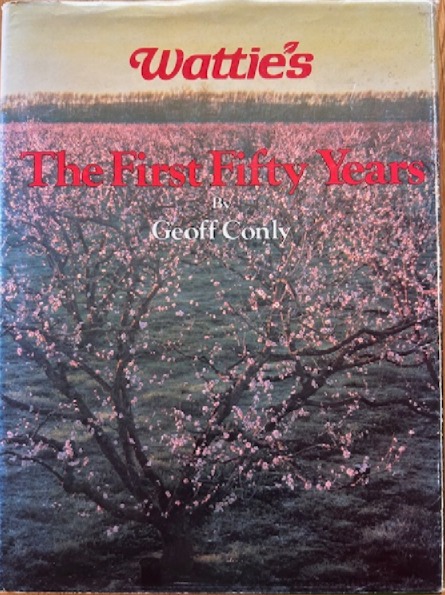
The book shown here was published in 1984 to celebrate the 50th anniversary of J Wattie Canneries Ltd, or in the vernacular, Wattie's. It was a J Wattie Canneries Impact Reflection, before that phrase got invented!
And like all those books, that get published by the wider fresh produce industry; eventually, a copy ends up on my bookshelf.
So, I can tell you that Watties was incorporated as J Wattie Canneries Limited in September of 1934. The Memorandum of Understanding that preceded setting up J Wattie Canneries is available as a matter of record and starts with this paragraph:
"It is generally conceded that there is a paramount need for the establishment of a factory in Hastings for the use of surplus fruit, tomatoes, and vegetables now wasting in incalculable quantity. The promoters of this association have secured from an old established, large, and flourishing firm of sauce manufacturers in Auckland a three-year contract to supply to them with fruit pulps of various varieties. This firm has contracted to purchase annual minimum quantities totalling in all eighty-two tons. These quantities are themselves sufficient to justify the commencement of a factory."
J. Wattie Canneries thus came into being "to carry on the industry, business, or trade of fruit and vegetable pulping and fruit and vegetable canning, jam, pickle, and sauce manufacturing. To carry on all or any of the business of growers of fruits and vegetables or either of them whatsoever kind, and of canners, bottlers, pulpers, bottle makers, bottle stopper makers, can makers, case makers, potters, manufacturers of and dealers in aerated and mineral waters and other drinks of essence, extracts..."
I am sure you get the drift. This was, at least in spirit, a cooperative venture between growers trying to stabilise prices through a cannery option that offered the chance to reduce waste and an entrepreneur who had spotted an opportunity.
Deregulation & Globalisation
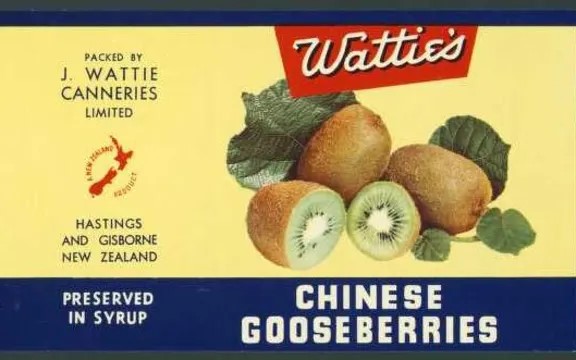 J Wattie Canneries Ltd Ref: Eph-B-FOOD-Watties-1959-07. Alexander Turnbull Library, Wellington, New Zealand. /records/22589910
The impact of deregulation on the country that started post- 1984 seems to have been forgotten today. When the Lange/ Douglas government started to deregulate industries with gay abandon (other than kiwifruit which experienced the opposite), impacts included increased ranges of what could be imported into the country in fast-moving consumer good categories, particularly shelf-stable ones; and fruit and vegetables in canned format formed part of it.
The next key move within the international macroeconomic establishment was globalization. The World Trade Organization being established and even free trade agreements being negotiated. This often also involved giving access to companies from one trade partner country, to make investments in Aotearoa New Zealand. To keep at least some check on developments in this space, New Zealand introduced a new watch dog, the Overseas Investment Commission. In 2005 the Commission was replaced by the Overseas Investment Office, now part of Land Information New Zealand.
In 1992, the US based H J Heinz company turned up in New Zealand and said,
"well, actually, you know, it would please and suit us if we were able to purchase Wattie's. We would call it Heinz Wattie's and together with our recent acquistions in Australia, we would take the world by storm. We want to build a global production base for all of those scenarios."
That sounded all very plausible, and in the fullness of time, J Wattie Canneries became Heinz Wattie's.
But eventually, of course, reality sets in. And one of the realities is that economies of scale in New Zealand are often not worth mentioning, when compared to global capacity or capacity in other countries, say Australia.
J Wattie Canneries Impact Reflection - Concluding Comments
The prevailing economic indicators that drive financial risk assessment can change rapidly these days. Case in point, the "Orange Avenger's" ill-fated attempts to bring Iran to its knees through what appear to be ad hoc bombing excursions without a visible exit ramp. Fuel cost are rising, transport operators will charge more, labour shortages for factory jobs are a permanent companion, the climate is changing and owners of canning facilties across the globe can ill afford to upgrade and modernize every single plant they own, particular in relation to the low value of the ingredients that go into the cans when compared to the cost of state of the art technology.
One really needs to just look at John Steinbeck's novel "Cannery Row" (1945) .
Granted, he was talking about sardines being canned in Monterey, California, but the principle is the same. When you no longer need canneries because the commodity isn't there anymore or the commodity isn't cheap enough anymore for you to earn the margins you think you need to have, you walk away.
And this way, a fantastic and exhilarating chapter of New Zealand's horticultural industry is getting closer to extinction and the jury is out on just how exactly this is playing out from this point forward.
It is a worry, because a thriving horticultural industry does need processing capacity; whatever else has changed in the last 80 years, this hasn't.
If you have any interest in this topic, you might want to start with a historical perspective. In November 1939, in the third month of World War II, a young research student submitted his Master of Commerce thesis at the University of Otago. The title of the thesis was "The New Zealand Canned Fruits Industry". The document is available as an open access .pdf file at the Otago University Archive.