- Home
- Fresh Produce System
- Fresh Produce Retail System
- Fresh Produce in Supermarkets
Fresh produce in Supermarkets
The first supermarket in New Zealand, Foodtown, opened in 1958. It was the brain child of Tom Ah Chee, a Chinese greengrocer, who had seen and admired the supermarket concept during a visit to the United States and decided that he wanted to introduce supermarkets into New Zealand. Fresh produce in supermarkets was therefore the norm for every Foodtown store built in the years to come, as well the for the company's competitors.
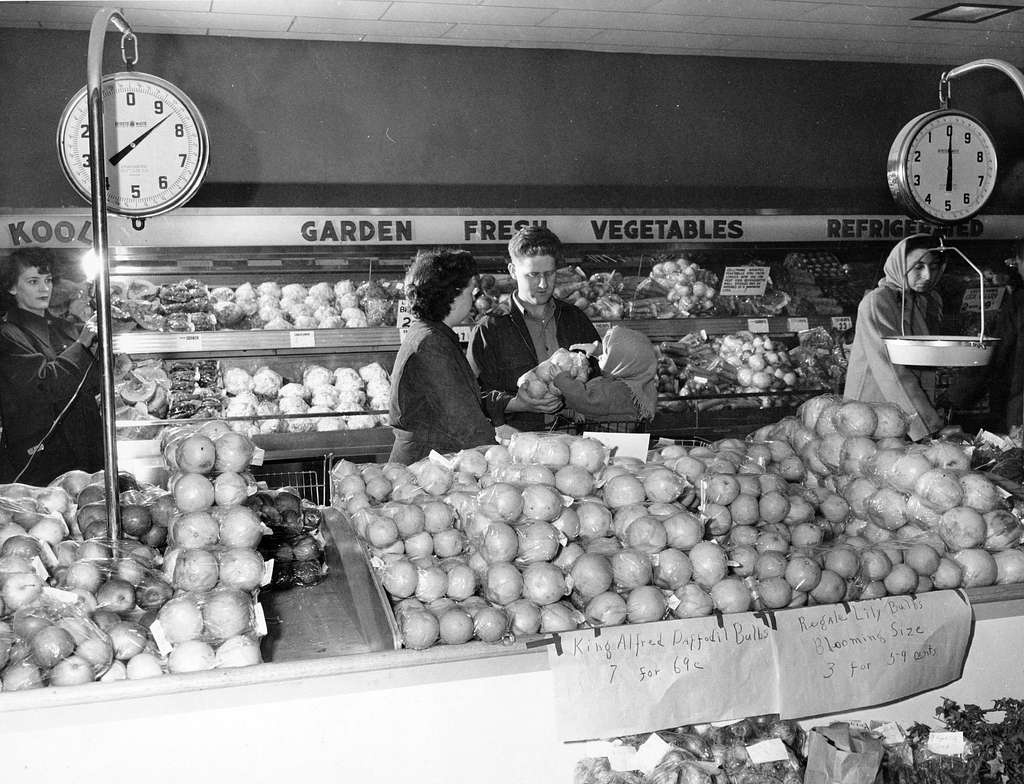
And all around what was then known as the "Western World", a new realisation dawned about the relationship between fruits and vegetables being sold in supermarkets and the implications for the wider fresh produce industry.
While relationship change or disruption is typically first noticed at the "coal face", i.e. where interested parties conduct business, it does not take long before academia starts paying attention.
In 1969, eleven years after the first New Zealand supermarket had opened, an academic paper surfaced entitled, "The supermarket and its influence upon the New Zealand market structure for fresh fruit and vegetables : a dissertation submitted at Massey University of Manawatu in partial fulfilment of the requirements for the degree, Master of Agricultural Science"
Fresh Produce in Supermarkets - A Summary of High Level Issues in 1969
The author, who can only be identified as A.N. Laird, and about whom nothing else is known at this stage, makes the following points in the introduction to his dissertation:
- "Supermarket merchandising policies differ in many ways to those which characterise the typical market structure of of grower, wholesaler and greengrocer."
- "Of paramount importance in this respect is the practice, which involves the supermarket's bypassing of the wholesaler and purchasing his suppliers directly from the grower."
- "Obviously, this must adversely affect the wholesaler, and it is for this reason that the constraint upon the extent of direct procurement by supermarkets receives particular attention."
- "The determining legislation behind that constraint, is enforced by the wholesale industry, and it limits the realisation of cost economies by growers and supermarkets from purchasing direct."
- "Furthermore, the grower views a laissez-faire policy of direct sales as a step towards domination by monopoly interests at retail. This is a point of conjecture, but its importance lies in the fact that auction is viewed by growers as a means whereby this possibility can be prevented."
Fresh Produce in Supermarkets - 1969 Conclusions
At the end of a very well considered and very appropriately crafted 185 page document, A.N. Laird presented a number of conclusions, including:
- "Supermarket sales of fresh produce will continue to increase."
- "The flexibility incorporated into supermarket pricing policy, ...clearly differentiates the supermarket's sales policy from that of the greengrocer, and is largely responsible for its continuing growth at the latter's expense."
- "The adaption of the supermarket to greengrocery retailing has had a beneficial effect in the New Zealand market structure for the product."
In other conclusions A.N. Laird commented upon the legal constraints that existed in the fresh produce industry in the year he handed in his dissertation. These legal constraints ought to be discussed in some detail and this will occur on a different page, which will in due course be linked here.
Fast Forward to 2022
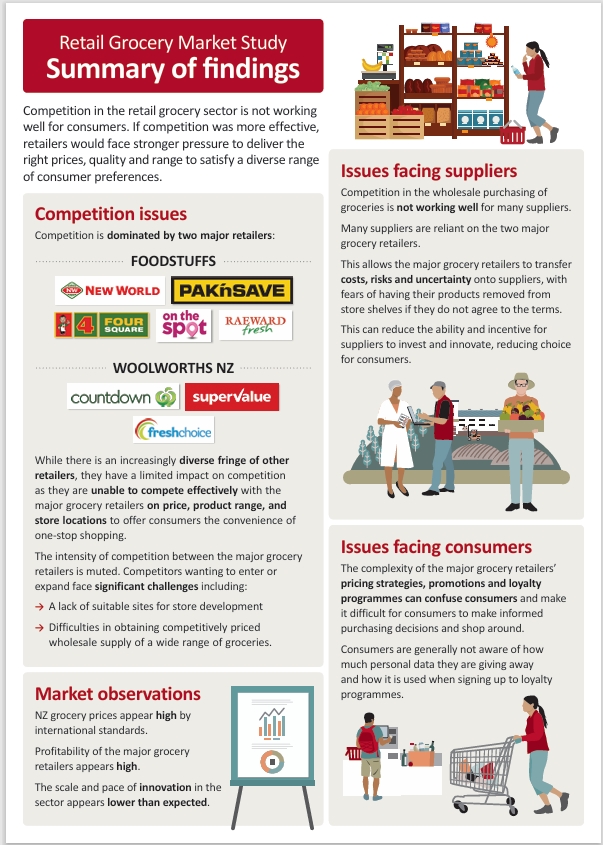
In 2022, the New Zealand Commerce Commission released its findings from a Retail Grocery Market Study it had started to work on in 2021. The summary of its in findings are shown the image to the left. The study itself and a number of related documents that have been released since can be found here.
A.N. Laird considered the legal framework around the fresh produce industry that existed in 1969 as a limiting constraint. These legal constraints no longer exist.
The Commerce Commission Retail Grocery Market Study Findings of 2022 have lead to new legislation being enacted that applies to the entire supermarket produce range, and the relationships supermarket have with all their suppliers. This includes their fresh produce suppliers, regardless of whether they are wholesalers or growers selling direct.
The supermarket industry has certainly changed since Tom Ah Chee's conversion from greengrocer to corporate supermarket operator.
As has Aotearoa New Zealand. Whether we look at the size of our population, or its demographics, or immigrations patterns, or the expansion our urban centres, or the degree of our integration into world trade principles & practices, or even climate change.
We cannot escape change.
The number of fruit and vegetable growers is decreasing. The property sizes controlled and managed by the growers that remain are increasing.
The phrase 'economies of scale' has become a permanent fixture in our language as well as in our managerial tool kit. In practical terms, this concept has also contributed to a reduction of supermarket chains operating in our country.
Rather than fill this page with a lot of data, I would like to refer you to the Commerce Commission Retail Market Study (linked above). There are plenty of data sets contained within those documents and there are a good place to start. But please do not take everything you read in these documents as gospel, because for every argument made by the regulator, there are multiple diametrically opposed views, opinions and beliefs held, depending on whom one is speaking to!
It would pay therefore to cast widely for background and information and data needed to form your own view..
What Awaits Us in 2026?
Watch this space for an update!
Back to the Fresh Produce Retail System