- Home
- Produce Or Horticulture Industry
- Fresh Produce Category Management
Fresh Produce Category management
The Origins of Category Management
The category management concept is generally attributed to Brian F. Harris, a former professor at the University of Southern California, who, in the late 1980s, felt a new engagement tool between FMCG suppliers and retailers was needed. Before we get into fresh produce category management though, it makes sense to look at the broader picture.
Harris had picked up on the changing relationship between suppliers and retailers, as particularly supermarket retailers had grown to the point where they no longer treated the marketing messages coming from suppliers as gospel, and instead had started to form their own views on what their customers were looking for, when they were visiting their stores, and, most importantly, what it was that brought these customers back week after week.
Viewed strategically, supermarket retailers started to exercise the leverage their exponential growth and concentrated purchasing power was beginning to afford them. FMCG suppliers were realising that a different engagement strategy was called for. They started to invest heavily into taking a structured approach towards their retailer relationships, particularly global brands such as Coca Cola, who were viewing and experiencing the new found retailer confidence, of wishing to redefine who was wearing the pants in the supplier/retailer relationship, as a global challenge.
In 2020, ECR, the community for efficient consumer response, published a very detailed, yet easy to follow report entitled, "Category Management: Yesterday, Today & Tomorrow." It is free to download and should be anyone's first port of call when one has the need to undertsand the category management concept better. Dr Harris was a contributor to the ECR report
The Coca-Cola Experience
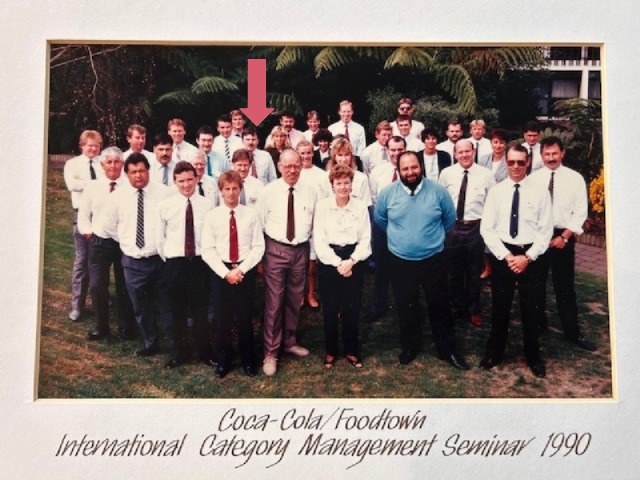
I had unexpectedly become Head of Produce for Foodtown Supermarkets in May 1989. By early 1990, I was still busy with:
- settling the produce merchandise & buying team into its first dedicated produce distribution centre.
- managing the industry fallout from our decision to withdraw from produce buying at auction.
- firefighting with selected operations managers, who viewed our disengagement from the produce auctions as the equivalent to commercial blasphemy of the highest order.
- cleaning up after the failed introduction of a highly futuristic produce distribution, merchandise and retail model, that I had inherited from my predecessor. It had been brilliant and ahead of its time, but also ill conceived, in the wrong hands and without sufficient governance and oversight.
- coping with the regular demands issued by our relatively new owners from the Coles-Myer C-Suite at their Melbourne Head Office, commonly known in neighbourhood, architectural and financial circles as "Battestar Galactica".
The last thing I therefore needed, or so I thought, was to be summoned to spend a couple of days in an off-site seminar, listening to Coca-Cola reps, who felt the urge to communicate chapter and verse about a new fandangled technique they had discovered to increase their shelf space in our grocery aisles!
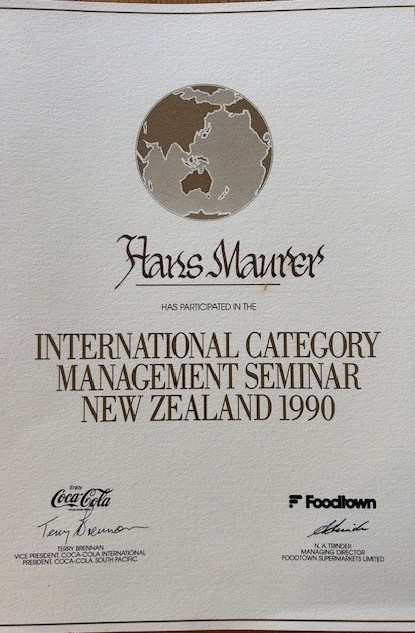
It became clear during the first morning that Coles-Myer and Foodtown wanted to be in the 'first mover' category (pardon the pun). This was why the delicatessen, meat, produce, bakery and general merchandise departments were also required to be in attendance, even though their relationship with Coke was purely in their capacity as potential consumers, rather than space, range and price decision makers.
By the time I emerged from the seminar at the end of Day 2, clutching my certificate, I had realised something else
For the grocers amongst us, the purpose of the seminar was to provide them with yet another 'paint by numbers' playbook, designed for branded, shelf stable and essential grocery products.
For the fresh food departments, i.e., delicatessen, meat, bakery and produce, the purpose of attendance was to provide a broader overview, in the hope that we would take the general principles of category management, we had been exposed to over the two days, away with us to figure out for ourselves, just what category management might mean, in my case, within the opportunities and constraints of the highly perishable fresh produce category.
And figuring it out for ourselves, was exactly what needed to happen. Literature on category management had begun to emerge but it was almost entirely centred on shelf stable groceries.
As it so happened, I was working on a couple of other major projects at the time, these being our strategy response to the deregulation of banana imports, and the future structure of the produce merchandise department, with a focus on morphing commercial reality on the ground here in New Zealand, with the perceptions and requirements expressed by the space cadets from Melbourne who were firmly convinced that New Zealand fitted somewhere between Tasmania and South Australia in terms of resources, management skills and sophistication required and could essentially be managed as a state.
How about trying to solve these two challenges whilst applying a category management approach?
Well, I did; or - at least I attempted to. And I will share my learnings from these projects in later posts.
Fresh Produce Category Management
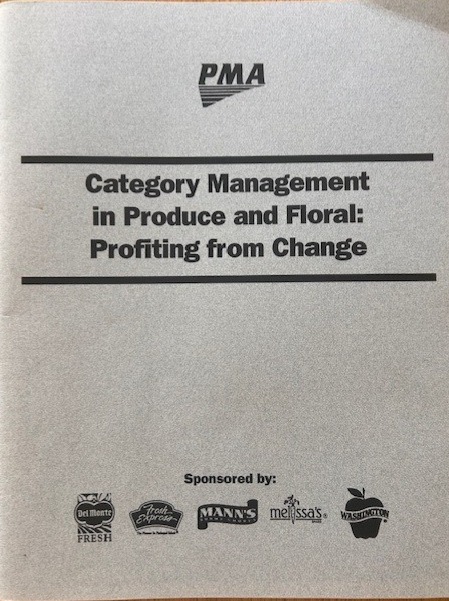
By 1995, PMA, the US Produce Marketing Association, these days better known as IFPA and pursuing a global mission, had formed its own view of what constituted Category Management. Its 42 page guide for industry, depicted here, started by introducing the then current ECR definition :
"Category management is a distributor/supplier process of managing categories as strategic business units, producing enhanced business results by focusing on delivering consumer value."
PMA then offered what it called a "slightly different" version of the ECR definition, namely:
"The distributor/supplier fact-based process of managing a category from source to market as a strategic business unit, producing enhanced business results by focusing on delivering consumer value."
...and shown exactly as I am showing it here, with two new phrases in bold type.
Given the implication that fresh produce category management required additional factors to be considered, I will discuss these two definition enhancements on a separate page, which will be linked here when completed. In closing, I want to refer to the brief explanation that PMA added below their definition. They wrote,
"Distributor refers to "retailer, service wholesaler, or mass-marketer."
That will be our starting point as we continue the discussion on fresh produce category management.